Senior Secondary Program
Senior Secondary (Years 11 – 12)
Aristar International School delivers a comprehensive Senior Secondary Program aligned with the Australian Curriculum, Assessment and Reporting Authority and designed to prepare students for both academic (ATAR) and vocational pathways.
The program combines:
- Academic rigour
- Applied learning
- Career-focused pathways Global readiness
Students are supported to transition into university, vocational education, or employment.

Curriculum Rationale
The Senior Secondary curriculum is designed to:
- Promote holistic development beyond academic knowledge
- Develop critical thinking, problem-solving, and communication skills
- Encourage collaboration, creativity, and innovation
- Foster global awareness, cultural sensitivity, and responsibility
- Support lifelong learning and self-directed inquiry
- The program provides opportunities for students to:
- Explore personal interests and career pathways
- Engage in extracurricular, creative, and community-based learning
- Build international perspectives and cross-cultural communication skills
- Develop networks and readiness for global opportunities
Program Vision
The Senior Secondary Program aims to develop students who are:
- Self-reliant and motivated learners
- Confident, creative, and innovative thinkers
- Ethical and responsible individuals
- Globally minded and culturally aware citizens
- Prepared for university, careers, and lifelong learning
ATAR Alignment
The Senior Secondary Program is aligned with the structure and expectations of Our Senior Secondary Program is aligned with the structure and expectations of the Australian State School Curriculum.
Academic Pathway (ATAR)
Students pursuing university pathways follow an ATAR-aligned program, which includes:
- Selection of academic subjects designed for university preparation
- Development of advanced analytical, research, and problem-solving skills
- Preparation for external examinations and scaling processes
- Study programs aligned to tertiary entrance requirements
The Australian Tertiary Admission Rank is used as a ranking system for university admission, reflecting student performance relative to peers.
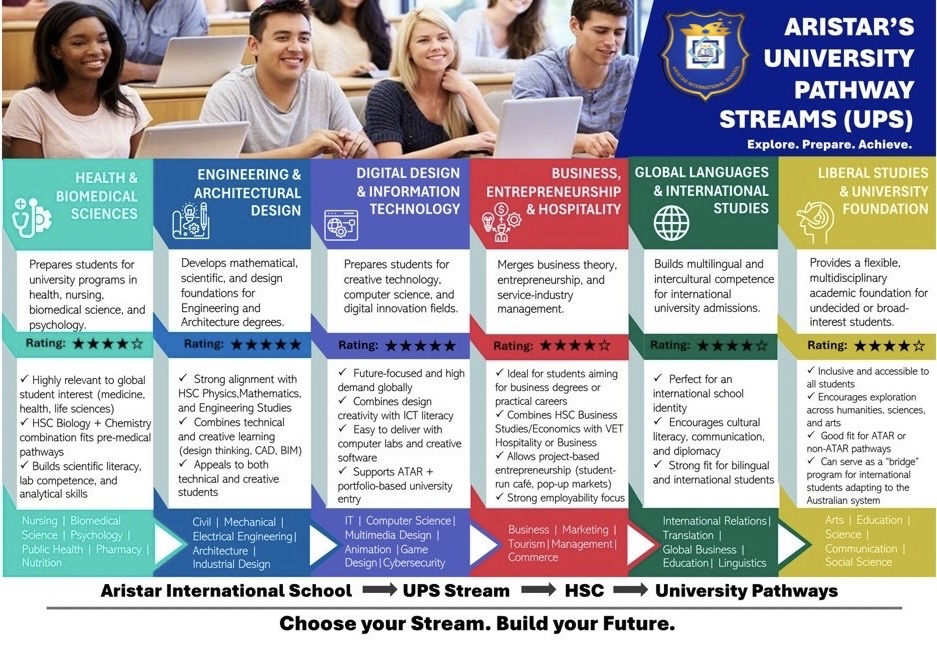
Students are guided to select subject combinations that support entry into fields such as:
- Medicine and health sciences
- Engineering and technology
- Business and economics
- Law and social sciences
General (Non-ATAR) Pathway
Students may follow a General pathway focused on:
- Practical and applied learning
- Workplace readiness
- Industry-relevant skills
- Continuous assessment (rather than high-stakes examinations)
This pathway supports transition into:
- Vocational education and training (VET)
- Employment
- Further training programs
Curriculum Structure
Students complete a combination of core and elective units:
- Core Units: 9.5 units/year
- Elective Units: 6.5 units/year
- Total: 16 units/year
- Total Hours:~1,280 hours/year
Subjects are structured to allow flexible pathways (ATAR / General / VET).
Subject Pathway Structure
ATAR-Aligned Subjects (Academic Focus)
Designed for students targeting university entry:
- English
- Mathematics (Methods / higher-level pathways)
- Chemistry / Physics / Biology
- Geography / History
- Advanced electives where applicable
These subjects emphasize:
- Academic writing and analysis
- Theoretical understanding
- Examination performance
- Research and inquiry
General Subjects (Applied Pathway)
Designed for practical learning and skill development:
- Essential English / English for Work
- Essential Mathematics / Practical Mathematics
- Earth and Environmental Science
- Work Ethics Focus:
- Real-world application
- Functional literacy and numeracy
- Workplace readiness
Vocational Education and Training (VET)
Students may combine school studies with industry-recognized qualifications:
- Business
- Information Technology
- Engineering
- Hospitality and Tourism
- Building Design
- Digital Media
Certificate pathways include:
- Certificate III and IV AQF qualifications
- Industry-aligned training programs
These contribute to:
- State equivalency
- Career readiness
- Direct employment pathways
Assessment and Achievement
Assessment is aligned with both:
ACARA achievement standards
- Senior secondary (ATAR/State-style) assessment practices
Assessment Types
- School-based assessments
- Examinations (ATAR pathway)
- Investigations and projects
- Practical and performance tasks
Grading and Reporting
Students are assessed using:
A–E grading scale
- Achievement relative to course standards
- Progress toward pathway requirements
For ATAR students:
- Performance is benchmarked against external examination standards
- Results contribute to tertiary entrance ranking
Pathway Flexibility
A key strength of the program is flexibility, allowing students to:
- Combine ATAR and General subjects (where appropriate)
- Transition between pathways with guidance
- Customize learning based on strengths and career goals
Students receive academic counselling to ensure:
- Appropriate subject selection
- Alignment with university prerequisites
- Balanced workload

University and Career Preparation
University Entry
- ATAR-based admission (Australia and international universities)
- Foundation and pathway programs
- Portfolio-based admissions (creative fields)
Career Pathways
- Industry-aligned VET qualifications
- Internship and practical experience opportunities
- Career-focused skill development
Expected Outcomes by End of Year 12
Students will demonstrate:
- Readiness for university entry (ATAR pathway) or employment/VET pathways
- Strong academic and/or applied learning outcomes
- Advanced communication, problem-solving, and research skills
- Independence, resilience, and adaptability
- Global awareness and intercultural competence